

Digital Stonemasonry: Raffaello Galiotto for Margraf
For centuries, the relationship between a sculptor and a block of natural marble was defined entirely by the physical limits of the hand chisel. The density of the stone demanded slow, linear subtraction, meaning that complex organic curves, hollow geometries, and deep repeating folds remained rare feats reserved for a handful of history's masters. In the contemporary luxury landscape, that old boundary has largely evaporated.
Through its long-standing collaboration with Italian designer Raffaello Galiotto, the historic stone house Margraf has pioneered a genuinely new creative language in stone. Galiotto doesn't treat marble as a flat, static cladding material. Instead, he approaches it as a versatile medium that can be reshaped through parametric design software and numerical control machinery, opening up spatial textures that simply weren't achievable by hand.
What makes Galiotto's partnership with Margraf so distinctive is his design ethos. He rejects the idea of using modern machinery to copy old, handmade shapes. Instead, he develops custom parametric software to discover forms that can only be realised through digital fabrication in the first place, working inside Margraf's production facility to carve directly into monumental blocks of fine Italian marbles such as Crema Nuova and Fior di Pesco Carnico.
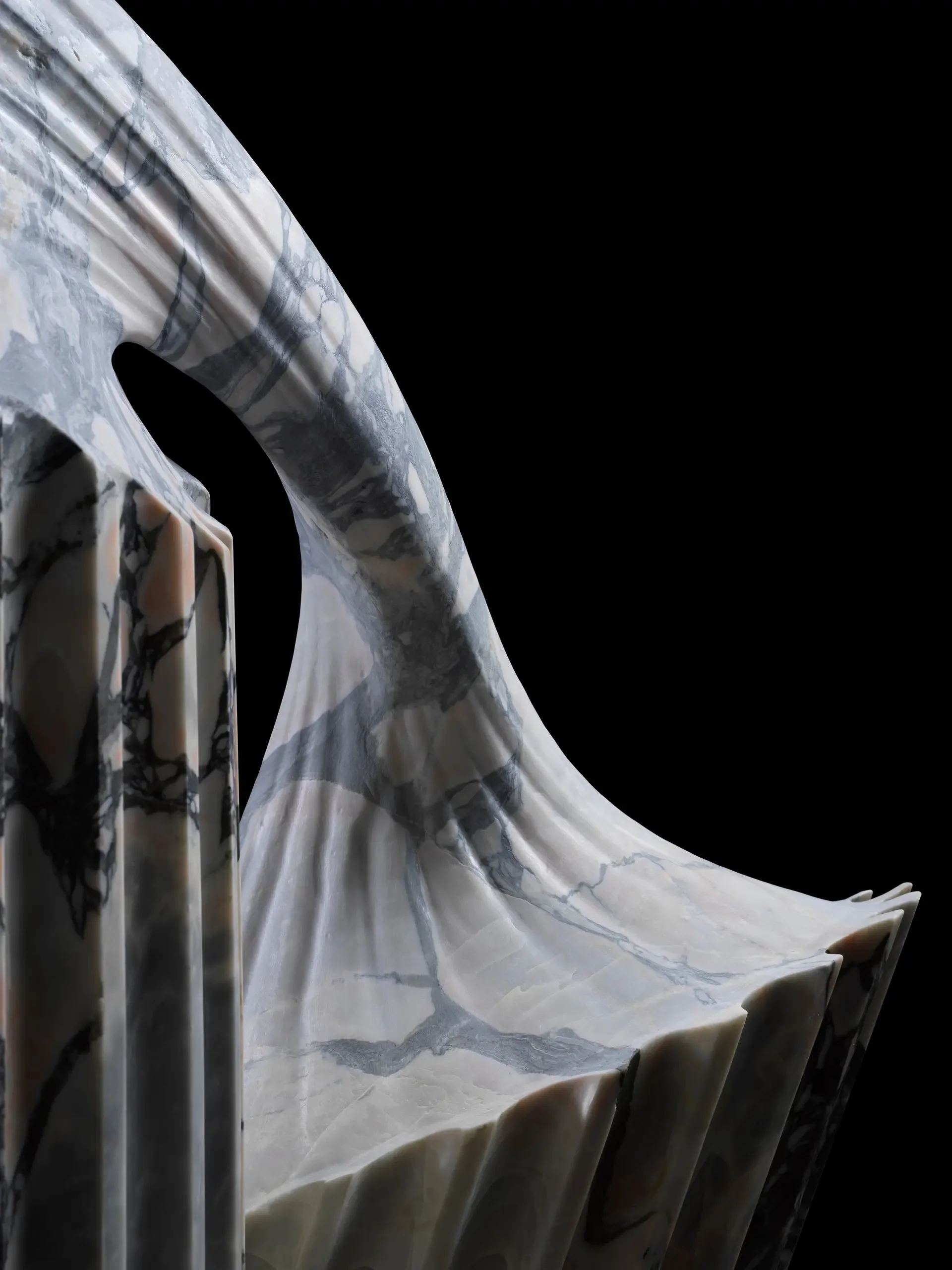
Raffaello Galiotto pushes the physical boundaries of natural stone, translating complex digital math into fluid marble architecture..
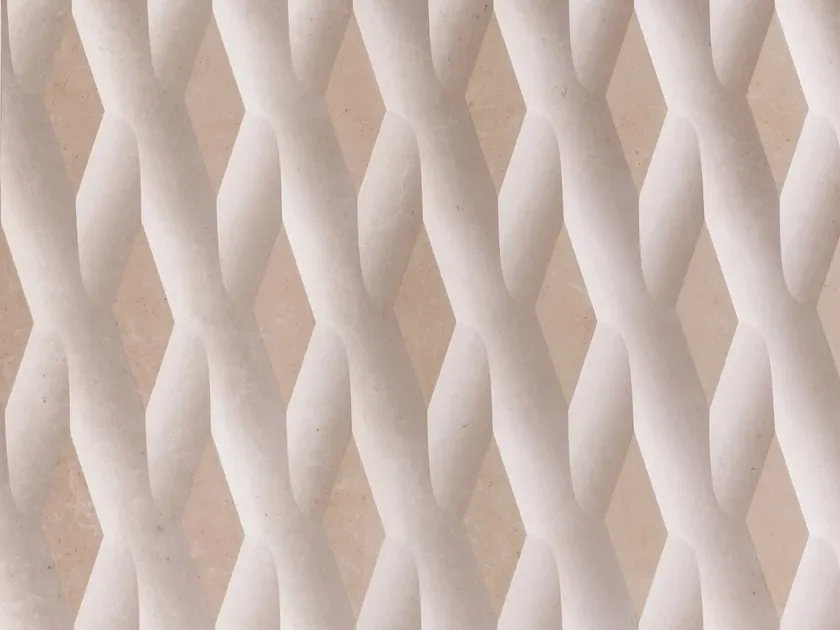
By engraving precise patterns into solid marble panels, Galiotto transforms heavy mineral skins into soft, textile-like feature walls..
That process shows up clearly in the Fluctus Collection, a body of work that turns rigid stone wall cladding into something that reads as soft and almost kinetic. Undulating panels are cut so that the raised wave of one panel forms the negative space of the next, and when natural light moves across a wall clad in Fluctus, the stone appears to shift in real time, its deep valleys holding shadow while the peaks catch the natural veining of the marble. It's a genuine bridge between raw material and digital precision, work that would be virtually impossible to achieve through traditional hand carving alone.
Specifying an installation of this kind demands real structural care on-site. Because these panels rely on complex, fluid patterns that have to connect precisely across multiple sheets, there's almost no margin for alignment error, a single joint sitting even a fraction of a millimetre out of place breaks the continuity of the whole design. At PietraCasa, we provide the technical link required to install intricate Italian natural stone concepts like this correctly. Our in-house team maps interior layouts using high-precision digital laser templates from the design stage, checks weight distribution against structural wall strength, and handles the carved panels with the care this kind of work demands on-site, pulling seams together with custom-formulated resins so the final result reads as one continuous surface.
Ready to bring advanced Italian stone design into your next project? Visit our Poole showroom to examine the tactile quality of premium marble samples, or contact our team to plan bespoke layout specifications for your space.